The Quiet Month
The last days, the last flights, the last chances

By late spring, I’m dreaming of sky. The falcon is heavy with a few new feathers, early in the molt, but I begin to see her moving through the air again—first in memory, then in hope. In early fall, we train on footing soft with dust, working muscle back into wings. The flights are short, low, uncertain. But October comes, and the cottonwoods turn yellow. Somewhere in the turn of light, she begins to climb again.
The start is possibility. The dogs run hot, the grouse flush green, and I am still too eager. It takes time to settle in—to stop hunting the perfect flight and start listening to what the season is offering. “We are life that wills to live, in the midst of life that wills to live,” Albert Schweitzer wrote—and out here, that feels true. The bird wills to fly. The grouse wills to rise. I will to be a part of something wilder. There are days I want to call it quits. Weeks when nothing comes together. Wind too strong. Snow too deep. Grouse gone silent. But then something happens—a falcon cast just right, a point from a setter so still it feels carved from the hillside—and the fire comes back. I say one more morning, and then another, and another still. This is not a season of plenty. It is a season of learning. A season of watching.
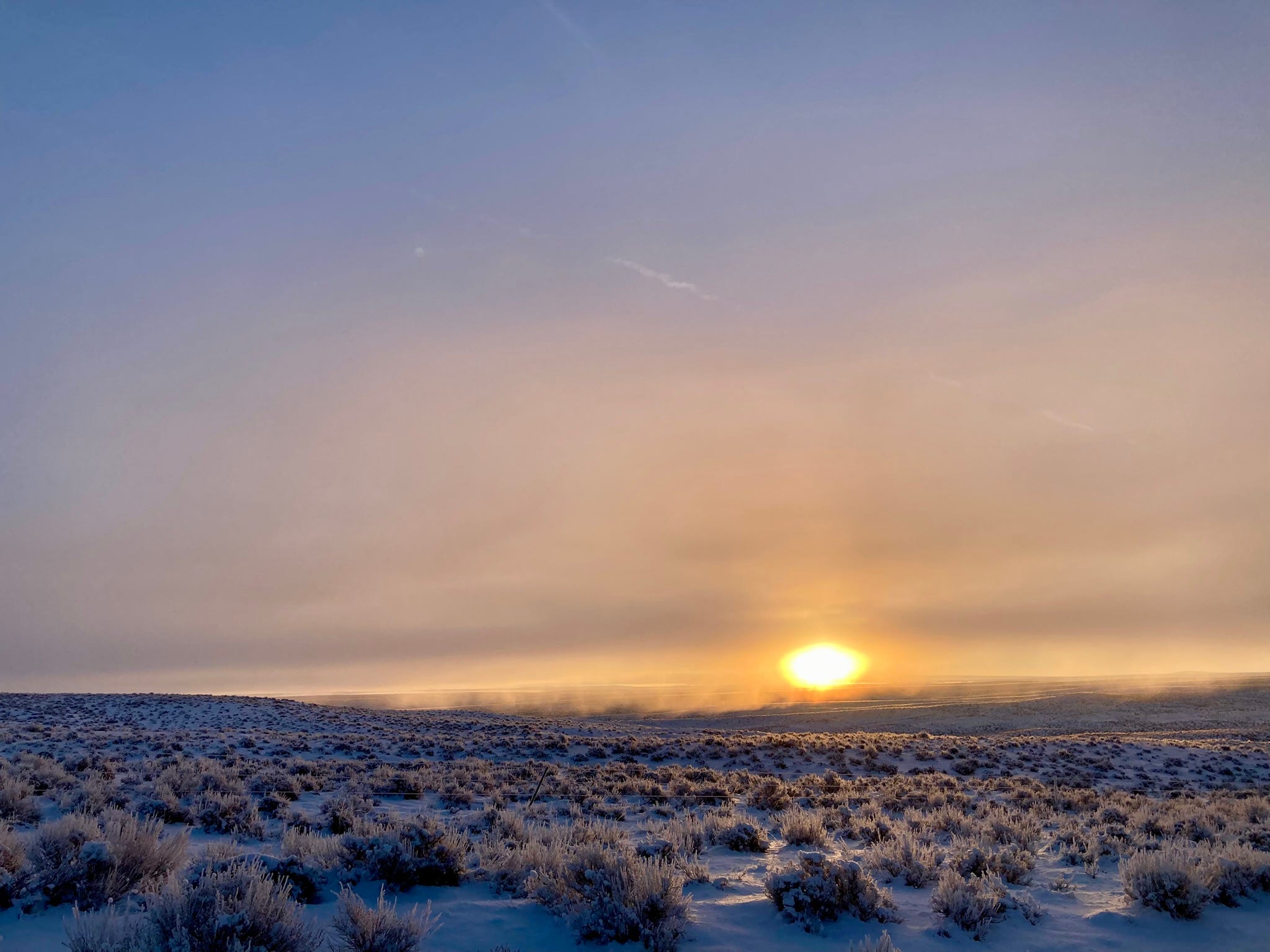
Out here, it is not mountains that hold me—it is the sage. A sea of silver‑green, rolling and wind‑worn, broken by the darker lines of draws and the open hush of small meadows. In October, the grouse are young and the air still carries warmth. By midday, it lifts you. Light is everywhere. Friends pass through on their way to elk country, chasing echoes in the high timber. I stay in the sage—something to learn, not to own. This place does not give itself easily. The birds move low, fast, smart. They run the seams of the draws and vanish in the thick stuff. The dogs learn to read it. So do I. There is no spectacle here—just rhythm, patience, small signs: a feather caught on a stem, a sudden silence.
By February, everything has thinned. Light, time, margin. The days are short and brittle. The predators have grown bolder—eagles, coyotes, the ravens that circle with intelligence. Danger feels closer. The grouse fly harder. Every movement carries more consequence. Still, I go. Because February matters. Not because it is abundant, but because it is exacting. There is little room for chance, and when the pieces come together—a point, a flush, a stoop—it feels like grace. You remember every one of them.
There’s talk now of closing February. A proposal from the Game and Fish Department. A concern for the birds, they say—and I believe it. Grouse populations range-wide continue to decline and estimates of sagebrush loss are near a million acres a year. But the hunters are always the group willing to protect habitat and give up seasons. Just a line drawn on the calendar, and with it, the quiet loss of a month. Fewer than five of us—maybe ten—fly grouse here in February, and we do not go often. But when we do, it matters. Most years, you can’t. What is at stake is not take—it is the right to witness, to learn, to belong in this small, difficult moment of the year. But the bigger problem looms - what will become of their landscape, their home?
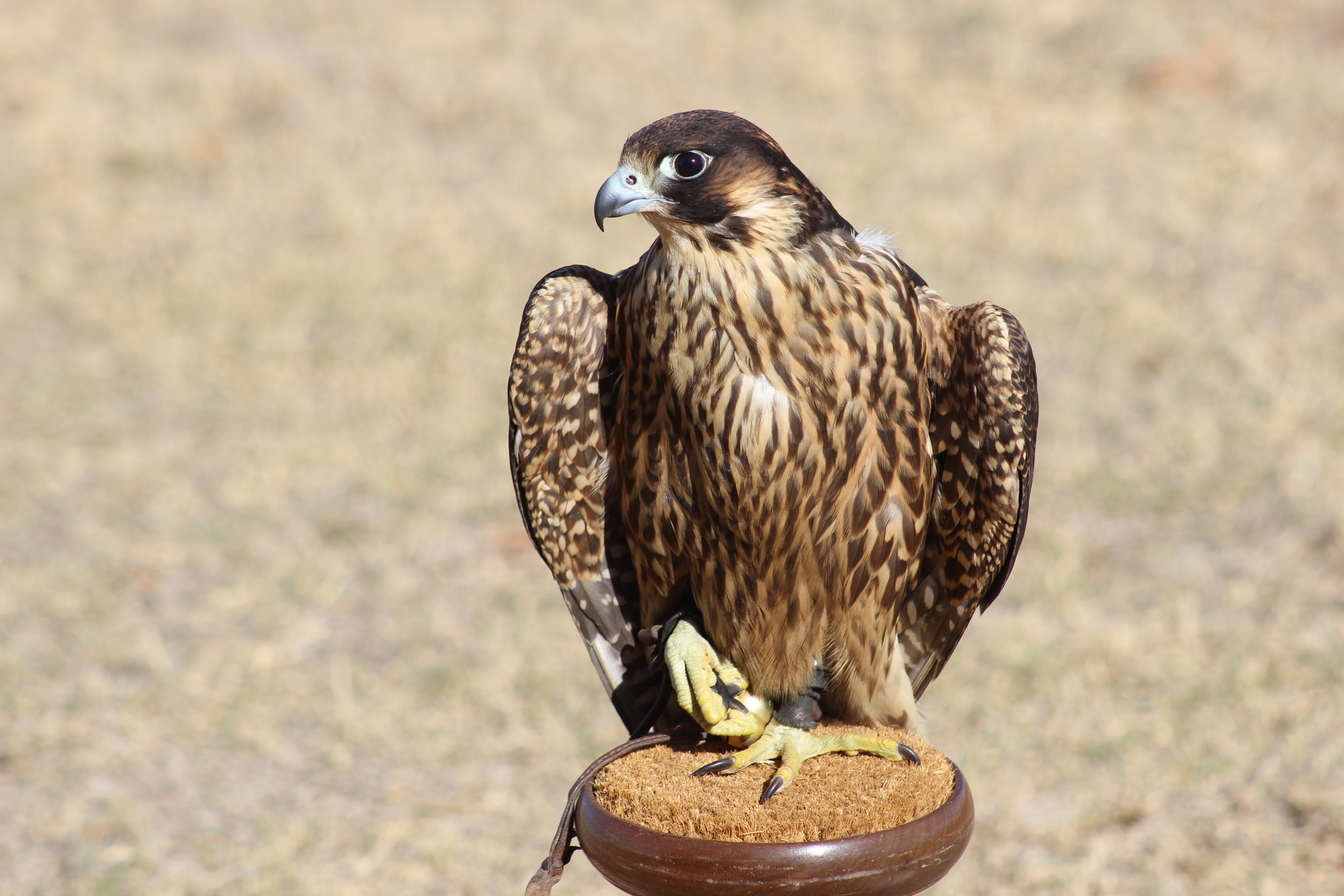
The peregrine I fly is not a bird I raised. She was caught from the wild as a brown beast, now blue‑backed, sharp‑eyed, shaped by wind and need. She hunts with me because it suits her. We know each other, but we do not belong to each other. She is in her fourth season now, and she has learned more than I’ve taught. She knows the dogs. Watches them. Anticipates them. When they slow, she circles tighter. When they run hot, she climbs. “The predator lives by killing, and yet it is not bloodthirsty. It is an instrument of a larger balance,” Barry Lopez reminds us—and she embodies that balance. Once, early on, she killed a bird and carried it to a cliff. Ate there in the wind, feathers scattering down the rock face. I thought I’d lost her. But when I showed the lure, she folded her wings and came. She is tenacious in the air, but not reckless. She waits for the moment the grouse breaks into sky—just for that. A quickness with no sound. She kills clean, or not at all. Flying her is never about command. It is about trust, habit, instinct, drive, and weather. Nothing is guaranteed. That is what makes the good flights feel like miracles.
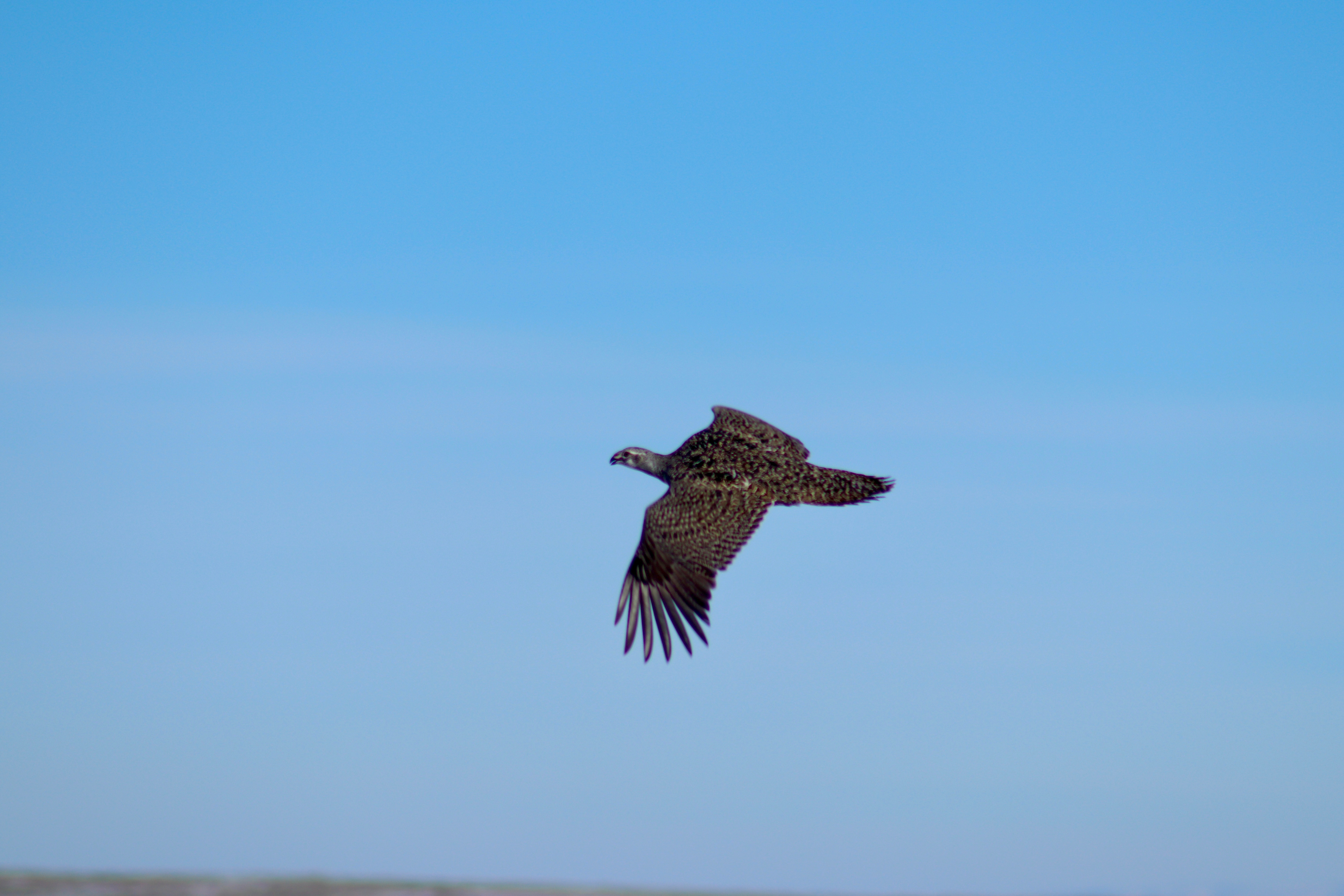
By February, the Sage grouse have changed. They are no longer the half‑grown or molting birds of September. They are full‑feathered now, thick with winter weight, strong from months of survival. They fly faster—stronger—smarter. My friend Jason, a dog trainer who has seen more birds than most, once watched one burst from the sage and said, “I’ve never seen a sage grouse fly that fast.”
It’s not just speed. It’s presence.
In winter, they are no longer tethered to the draws or the water edges. They range. They select. They return to favored spots—ridges, meadows, bowls in the sage—as if drawn by more than just habitat. Some days, it feels like ritual. As if they are keeping appointments with the land. The way they gather, loosely, with purpose. It feels like memory. Observance. Maybe even ceremony. “I am a frayed and nibbled survivor in a fallen world, and I am getting along,” Annie Dillard wrote. That sense of persistence lives in every wild bird that rises here. They are hard to find, harder to flush, nearly impossible to catch. Which is exactly the point. To see a grouse break from the sage under a February sun is to witness a decision. They do not leap by accident. They gamble. They go early, low, far. Sometimes the dogs miss it. Sometimes even the falcon, high and ready, cannot close the gap. And still, we go. Not for take. For chance. For a deeper human calling.
It happened on a morning where everything felt held in place—the sage, the air, the hush before sun. We were between the soft crests of the brush, that wide rhythm of the land some call the sagebrush sea. Cold held tight to the hollows. The sky had just begun to pull light over the ridges. We had seen the grouse—nervous shapes at the far edge of a shallow valley. They were already moving, and the slip was less than ideal. My friend Dan offered up his spot in the line up. I readied the falcon. There is always tension in that moment—not whether a bird will be taken, but whether a chance will be given. Whether you’ll step forward in time to let the pieces try to align. Sometimes they rise before you can move, and you’re left with the ache of almost. This time, the grouse lifted in waves. They did not flush—they departed. In clusters, fast and low, to places I never follow. But in that chaos, one bird rose in line with the falcon, who had circled unseen above. A line closed between them. She stooped hard and fast. Found the opening. Took the bird clean. It was not the kind of flight people write about for spectacle. But it held everything: the patience, the gamble, the wildness that refuses to be owned. The fact that she found her bird in the midst of all that disorder felt, if not ordained, at least right.
The open winter days in February feel like gifts. After so many bitter ones—skies sealed tight with wind and cold—those moments of stillness, of flight, feel outside of time. They are rare. They are fleeting. And they are everything. “In the same moment in which we resolutely accept the necessity of living at the cost of other life, we become aware of the sanctity of all life,” Schweitzer wrote—and I feel that weight when I leave what remains behind in the field. If 2025 was the last February I will fly grouse, it was a good one. I was not alone. There were friends, and dogs that knew their work, and birds that reminded us why they are still here. The falcon flew clean. The points were true. And more often than not, the grouse got away. You never know something might be the last until it is. And when that comes, there’s no announcement. Just the quiet absence of what once was—a silence in the draws, a birdless sky, a door that used to open and now does not. I do not ask for more birds. I do not ask for easy days. I only ask for the chance to keep learning this season a little longer. Because February is not about taking. It is about being allowed to see.